The Role of Long-Term Parking Enforcement in Successful Parking Management
Efficient parking management is much more than just providing parking spaces—it affects customer satisfaction, profitability, and a location’s appeal. One of the biggest challenges in this regard is managing long-term parkers.
Without consistent monitoring, problems can quickly arise: financial losses due to blocked parking spaces, frustrated short-term parkers who can’t find a spot, and general disorder that tarnishes the parking facility’s image. This particularly affects operators of parking garages, company parking lots, or residential complexes, for whom fair and efficient use of the space is essential.
Modern technologies offer effective solutions in this area. Automated systems for monitoring long-term parkers help maintain order, use resources efficiently, and increase the profitability of parking areas. In addition, digital parking solutions enable seamless management, reduce the need for manual monitoring, and optimize parking space availability over the long term. Let’s take a closer look at the key challenges—and show how smart solutions can optimize your parking management.
Urbanization and Growing Challenges in Parking Areas
Increasing urbanization poses major challenges for cities. More and more people are moving to urban areas, which is increasing traffic congestion and driving up the demand for parking spaces. Since the expansion of alternative modes of transportation often fails to keep pace, an imbalance between supply and demand is emerging—with noticeable consequences.
Studies show that drivers in Germany spend many hours each year looking for parking. This unnecessary traffic caused by the search for parking not only causes stress but also results in economic losses, particularly for retailers. Those who can’t find a parking spot often drive on—and spend their money elsewhere. Especially in densely populated downtown areas, the lack of parking often leads to illegal parking, higher administrative costs, and an increase in parking tickets. In addition, traffic generated by the search for parking—due to unnecessary trips—harms the environment, increases noise pollution, and contributes to an inefficient urban landscape.
Long-Term Parkers and the Challenge of Inefficient Parking Space Utilization
Long-term parkers block parking spaces that are actually intended for short-term visitors, thereby reducing parking turnover. This can result in lost revenue for business owners, as potential customers stay away due to a lack of parking.
Company parking lots are often empty outside of business hours, while surrounding streets are crowded. There is great potential here for more flexible use: Intelligent control systems can help allocate parking spaces more effectively and make better use of available space—to the benefit of everyone involved.
Another problem is that long-term parkers often occupy prime parking spaces, thereby causing shortages in particularly sought-after areas. The solution lies in strategic, digitally supported parking management that efficiently manages long-term parkers, prevents misuse, and makes optimal use of available space. The use of smart systems enables a more equitable distribution of parking spaces, so that all user groups—whether long-term parkers or occasional users—benefit from well-planned parking utilization.
Long-Term Parking Enforcement: These Challenges Must Be Addressed
- Misuse of Parking Permits: Unauthorized use of long-term parking permits not only leads to financial losses but also to an unfair distribution of parking spaces. Parking permits are often passed on, copied, or even forged—especially in commercial areas where parking spaces are limited and in high demand. A lack of transparency and oversight enables this misuse, which in turn leads to frustration among authorized users and higher administrative costs for operators.
- Overuse and Inefficient Use: Long-term parkers who occupy parking spaces for excessively long periods significantly exacerbate the parking shortage. This is particularly problematic in areas with high visitor traffic, such as downtown areas, hospitals, or shopping centers. In these locations, uncontrolled use results in there being hardly any free parking spaces available for customers, patients, or residents. Fair allocation of parking spaces requires clear rules and consistent monitoring to ensure that parking is used in accordance with demand.
- High Cost of Monitoring: Manual monitoring methods are not only time-consuming but also costly and often ineffective. Random checks by security personnel or parking attendants cannot ensure comprehensive monitoring. Modern technologies such as license plate recognition and digital parking management systems are therefore essential for efficiently monitoring long-term parkers, identifying violations, and minimizing administrative burdens.
Digital Solutions for Effective Long-Term Parking Enforcement
Data Analysis and Reporting: More Than Just Monitoring—Smart Parking Planning with Data
Modern systems for monitoring long-term parking offer far more than just monitoring of parking space usage. They generate valuable data that enables more precise control of parking management and leads to better decisions in the long term.
Data Collected and Its Uses:
- Parking Duration and Utilization – Determines how long parking spaces are used and when peak times occur.
- User Groups and Usage Patterns – Provides insights into which target groups use the parking lot the most.
- Violations and Illegal Parking Statistics – Identifies critical areas with recurring violations and enables targeted countermeasures.
Benefits of real-time data:
- They enable a direct response to congestion by, for example, recommending alternative parking areas or dynamically adjusting rates.
- Optimize staffing schedules for the maintenance, cleaning, and inspection of parking facilities.
Strategic Benefits of Data Analysis and Reporting:
- Trend Analysis and Demand Forecasting – Identifies long-term usage patterns and helps prevent future capacity bottlenecks.
- Price Optimization – Supports flexible pricing based on peak and off-peak usage times.
- Future Planning – Provides a sound basis for decision-making regarding the expansion or restructuring of parking areas.
- Marketing Effectiveness – Shows how targeted offers or discounts can influence parking lot usage.
A data-driven approach makes parking management not only more efficient but also more economically sustainable. How can we effectively and reliably monitor long-term parkers? The answer lies in modern digital solutions that are revolutionizing parking management.
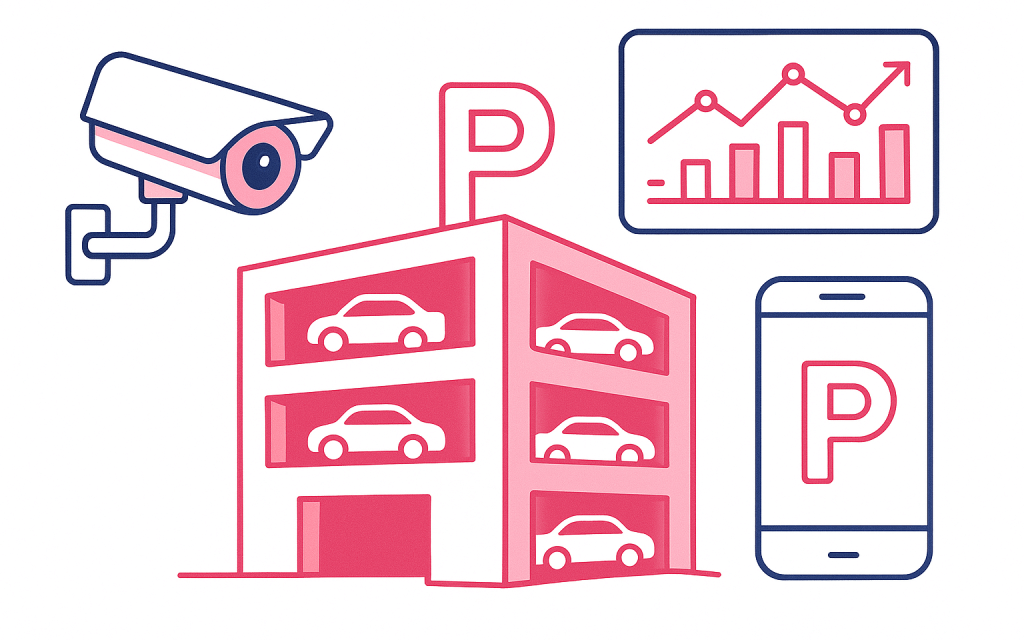
- Automated Parking Monitoring ensures seamless monitoring. Systems with license plate recognition (LPR) automatically detect vehicles and cross-reference them against a database. In addition, parking sensors provide precise real-time data on the occupancy of individual parking spaces. These technologies make it possible to immediately detect violations and directly implement measures such as digital warnings or access restrictions.
- Smart Parking Management Software consolidates all processes—from issuing and managing parking permits to recording violations and optimizing space utilization. Real-time data helps identify bottlenecks early on and take strategic countermeasures. Seamless integration with access control and payment systems ensures smooth operations.
- Mobile Apps for Users and Operators play a crucial role. Users can find, reserve, and pay for parking spaces in real time without physical contact. Operators, in turn, benefit from digital management tools, mobile monitoring, and direct communication with users. Many apps also offer navigation features to guide drivers directly to available parking spaces. Integration with digital payment systems ensures a flexible and user-friendly experience.
Data Protection and Legal Certainty: Key Considerations for Implementation
Digital solutions for monitoring long-term parking offer many advantages—but data protection plays a crucial role in this context. Systems such as license plate recognition collect personal data, which is why they must be designed to comply with the GDPR.
It is important that companies:
- use the collected data only for the intended purpose,
- provide transparent information on data usage,
- Take technical and organizational measures to protect the data.
Solutions that comply with data protection regulations not only minimize legal risks but also strengthen the trust of parking lot users.
Ensure Order and Efficiency – Why Reliable Long-Term Parking Monitoring Is Essential
Professional monitoring of long-term parkers is the key to efficient parking management. It reduces costs, optimizes utilization, and ensures user satisfaction.
Take Action Now – Efficient Long-Term Parking Monitoring with ParkRaum-Management PRM!
Are you ready for the next step? PRM Parken offers customized digital solutions that combine legal certainty and efficiency. Contact us today for a personalized consultation—together, we’ll optimize your parking management for the long term!