Parking Guidance Systems for Cities, Municipalities, and Private Parking Garages: How Smart Parking Works
Parking in cities and towns can often be stressful and time-consuming. Especially in high-traffic areas, the search for an available parking space can be a real test of patience. However, this problem affects not only drivers but also businesses and companies that want to provide their customers with sufficient parking options. For this reason, parking guidance systems are increasingly being used in cities, towns, and private parking garages. This smart technology is designed to help make the search for an available parking spot easier and more efficient.
How do parking guidance systems work for cities, municipalities, and private parking garages?
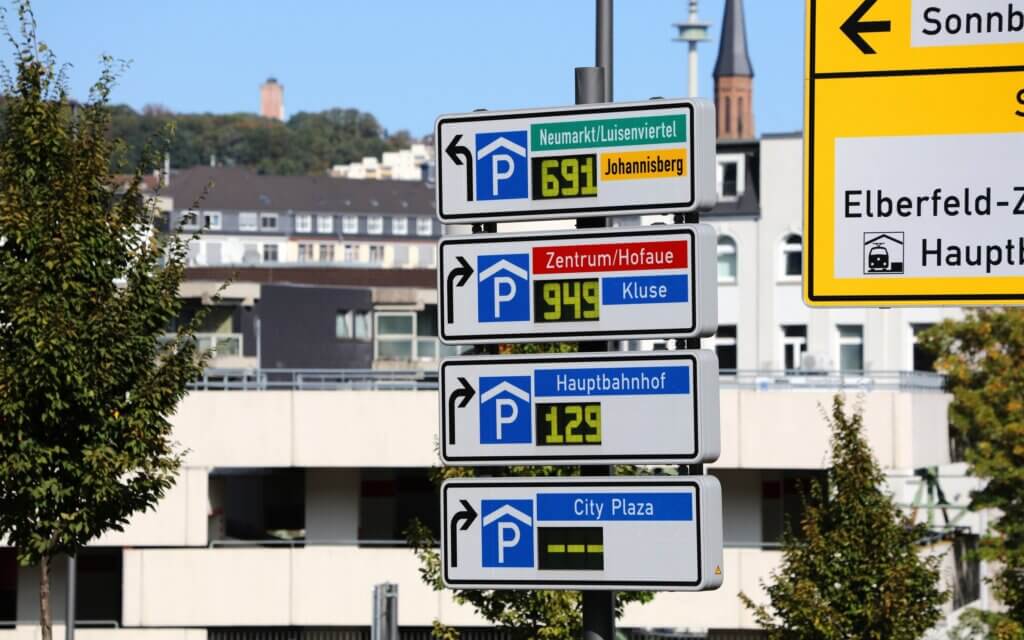
Parking guidance systems for cities, municipalities, and private parking garages are based on smart technology that makes parking easier for drivers. These systems use sensors, cameras, or magnetic fields to detect available parking spaces and transmit this information to a central control system. This system analyzes the information and relays it to drivers. This is typically done via digital displays that show drivers where they can find available parking spaces.
Benefits of Parking Guidance Systems for Cities, Municipalities, and Private Parking Garages
Parking guidance systems offer numerous benefits for cities, municipalities, and private parking garages:
- Increased Efficiency: By using parking guidance systems, drivers can find an available parking space more quickly and efficiently, which can help reduce traffic and ease congestion on the roads.
- Improved Parking Lot Utilization: By automatically tracking available parking spaces, parking lot utilization can be optimized. This can help reduce the number of parking spaces needed, which in turn saves space and resources.
- Increased Customer Satisfaction: Parking guidance systems can help customers find a parking space more quickly and easily, which can lead to higher customer satisfaction.
- Reduced Parking Fees: By optimizing parking lot utilization, the need to raise parking fees can be reduced.
Types of Parking Guidance Systems
There are various types of parking guidance systems that can be used in cities, municipalities, and private parking garages:
- Ultrasonic parking guidance systems: These systems detect available parking spaces using ultrasonic sensors mounted on the ceiling of parking garages or on the ground in parking lots, and transmit the data to a central data center.
- Magnetic-field-based parking guidance systems: These systems use magnetic-field sensors to detect available parking spaces. They generate small magnetic fields that are detected by the sensors, indicating whether a parking space is available or occupied.
- Camera Systems: Cameras can be used to detect and identify available parking spaces. This involves capturing images of the parking spaces and analyzing them using software.
- Combined Systems: Combined systems are also frequently used; these systems employ multiple sensors and technologies to detect and display the availability of parking spaces.
FAQ
What parking lot monitoring technologies are available?
Modern parking lot monitoring relies on various digital technologies that enable efficient and reliable monitoring. Camera-based systems equipped with artificial intelligence form the core of these solutions and can monitor several hundred parking spaces simultaneously, detecting vehicles in real time and performing automatic number plate recognition (ANPR). As an alternative or supplement, ground sensors are used to detect parking space occupancy with high precision; these sensors are weatherproof and operate at temperatures ranging from -25°C to +65°C. The systems work in conjunction with IoT devices and edge computing, enabling seamless integration into existing parking guidance systems. Modern solutions often do away with physical barriers and instead rely on fully digital monitoring with AI-powered analysis, achieving an accuracy of up to 99%. The collected data is analyzed in real time and can be used for various purposes, from optimizing parking to preventing illegal parking.
How can parking enforcement help prevent unauthorized parking?
Parking lot monitoring offers various effective ways to prevent unauthorized parking. Modern systems such as electric parking barriers controlled by handheld transmitters, video surveillance with AI-powered license plate recognition, and sensor technology enable reliable monitoring of parking spaces. In addition, physical barriers such as bollards or chains can be installed to grant access only to authorized individuals. In the event of violations, illegally parked vehicles may be towed, which is legally permitted under the property owner’s right of self-help. Clear signage in parking areas and clear warnings of the consequences of misuse are important preventive measures.
What legal requirements apply to parking enforcement?
Parking enforcement by private companies is subject to a clear legal framework:
Contractual Basis
Private parking enforcement is based on the principle of a contractual agreement—by parking a vehicle, a contract is formed between the driver and the parking lot operator. The parking rules and any applicable penalties must be clearly indicated by clearly visible signage.
Data Protection Requirements
The following requirements must be met for video surveillance and automated license plate recognition:
- Clear signs indicating surveillance before entering the premises
- Collection of only the necessary data (identifiers)
- Granting a grace period for leaving without penalty
- Deletion of the data after leaving the parking lot or, at the latest, at the end of the day
Liability and Enforcement
The vehicle owner is not automatically liable for parking violations. Only the actual driver, as the contracting party, is liable for payment. However, parking lot operators may:
- Issue traffic tickets and have vehicles towed
- Require the owner to sign a cease-and-desist letter
- Request that the vehicle owner cooperate with the investigation to identify the driver
Can a parking enforcement system be integrated with an existing parking guidance system?
Parking lot monitoring systems can be easily combined with existing parking guidance systems, as modern systems feature open interfaces and API connections that enable seamless integration. The real-time data collected on parking lot occupancy can be directly integrated into existing applications and management systems, allowing for more efficient monitoring and control of parking areas. In most cases, existing surveillance cameras can also be reused and connected to new control units. This integration unlocks additional features such as dynamic pricing, license plate recognition, and detailed occupancy analyses, which make the parking facility even more cost-effective.
How are violations such as illegal parking documented in a digital parking enforcement system?
With digital parking enforcement, parking violations are documented fully automatically by a system that captures license plate numbers. Special LPR (License Plate Recognition) cameras capture a vehicle’s license plate number as it enters and exits the lot and store this information, along with the date and time, in a database. The cameras photograph only the license plate, not the entire vehicle or its occupants. Integrated software analyzes the data and cross-checks it against authorizations such as reservations, rental agreements, or app bookings. If a violation is detected, the vehicle owner’s information is obtained from the relevant registration authority. Unlike a traditional parking ticket left on the windshield, the vehicle owner receives the bill by mail a few days later.
What are the benefits of a modern parking guidance system?
A modern parking guidance system offers numerous benefits for drivers and operators: It reduces traffic caused by drivers searching for parking spaces through real-time navigation to available spots, thereby decreasing traffic congestion and CO2 emissions. The intelligent control system optimizes parking space utilization and increases efficiency. For drivers, this means less stress and time saved when looking for a parking spot. Operators benefit from improved monitoring via sensors and cameras, as well as comprehensive analytics to optimize their services. Additionally, modern systems enable integration into smart city concepts and offer flexible reservation options.
What types of parking guidance systems are available, and which ones are best suited for large parking lots?
Parking guidance systems can be divided into various technological categories, each of which offers specific advantages and disadvantages for large parking lots. The most important systems are:
Sensor-based systems
Magnetic-field-based systems use ground sensors to detect parking space occupancy, while ultrasonic and infrared systems detect the presence of vehicles using appropriate sensors.
Camera-based systems
These systems use video technology to identify available parking spaces and are particularly effective for large areas, as they can monitor multiple parking spaces at the same time.
Digital Systems
App-based solutions provide real-time information on parking availability and reservation options. These can be combined with GPS technology to enable precise navigation to available parking spaces.
Recommendation for large parking lots
A combination of camera systems and app-based management is particularly well-suited for large parking lots. This offers:
- Real-time monitoring of parking lot occupancy
- Advance planning and booking options
- Efficient Traffic Management
- Integration into existing barrier systems
Modern license plate recognition combined with app-based control offers the most comprehensive solution for large parking lots, as it optimizes both access control and the search for parking spaces.
How does a digital parking guidance system work, exactly?
A digital parking guidance system collects and processes parking data in real time using various sensor technologies and makes this information available to drivers. Data is collected via ground sensors, magnetic field sensors, cameras with license plate recognition, or ultrasonic sensors, which determine the occupancy status of parking spaces. This data is transmitted to a central control unit, which evaluates it and forwards it to drivers via digital display boards, smartphone apps, or navigation devices. This directs drivers directly to available parking spaces, reducing traffic caused by drivers searching for parking and optimizing parking space utilization. The software also enables digital management of parking areas with features such as cashless payment, reservations, and utilization analyses.
How does a parking guidance system improve customer satisfaction?
A parking guidance system significantly increases customer satisfaction by enabling drivers to find an available parking space quickly and stress-free. Real-time information on available parking spaces noticeably reduces wait times and traffic congestion, leading to a more relaxed parking experience. The automatic detection of available parking spaces also optimizes overall parking lot utilization and prevents frustrating drives in search of a spot. Modern systems offer additional convenience through digital payment options and protect customers from issues such as lost or damaged tickets, which has a positive impact on the overall customer experience.
How is a parking guidance system installed and put into operation?
A parking guidance system is typically installed and implemented in several steps. First, a needs analysis is conducted and the parking area is customized. The actual installation then involves setting up the necessary hardware, such as sensors (e.g., cameras, ultrasonic or magnetic field sensors), digital display panels, and a central control unit for data processing. The sensors detect the occupancy of the parking spaces and transmit this information in real time to the control unit. The processed data is then relayed to drivers via the display boards or a mobile app. Following the technical installation, system integration and connection to existing infrastructure take place. The entire installation and commissioning process can be completed within a few days. A service team is then available for ongoing support and optimization of the system.
Can a parking guidance system be integrated with existing IT and building management systems?
Modern parking guidance systems can be easily integrated into existing IT and building management systems. Through open interfaces (APIs) and standardized protocols, parking management solutions can be connected to various business applications, time-tracking tools, payroll systems, and barrier systems. Integration is typically software-based and requires no costly hardware investments. Parking data from various sources—such as sensors, barriers, and parking meters—can be consolidated into a central platform and shared. Cloud-based systems also enable rapid implementation without major structural changes. This networking creates valuable synergies between different systems, benefiting both operators and users.
How secure and GDPR-compliant are modern parking guidance systems?
Modern parking guidance systems are designed in compliance with strict data protection guidelines and are GDPR-compliant. License plate recognition is based on the parking operator’s legitimate interest (Art. 6(1)(f) GDPR) and is subject to clear rules: The captured license plates are automatically deleted upon completion of the parking process, provided there is no parking violation. Only the data necessary for the parking process is collected, and no images of individuals are stored. Data processing is limited to the license plate and entry and exit times, while the data is stored in Germany. In addition, parking lot operators must indicate the license plate capture via appropriate signage before the entrance and allow a grace period during which the parking space can be vacated without an obligation to pay. All processing is encrypted and carried out in accordance with technical and organizational measures to protect the data.
Conclusion
Parking guidance systems for cities, municipalities, and private parking garages offer numerous benefits for drivers, businesses, and the environment. They make it easier to find available parking spaces, optimize parking space utilization, and help reduce traffic congestion. The various types of parking guidance systems also offer a high degree of flexibility and can be customized to meet users’ specific needs. Despite potential upfront costs, investing in parking guidance systems is often worthwhile in the long run.